Overview
This case study is about how I add elements to improve user experience and value proposition than competitors. The application I was designing for was a pre-surgery readiness checker platform. Simply to put, before the surgery, the service provider would provide an application URL for the patient to mark the checklist, checkmark the set of checklist items to track how prepared they are in terms of medically, legally, and in terms of financially, and after support and logistics upon the surgery.
User Problems
Designing for the Problem
There were two things to consider designing for this problem:
- · Putting together the use cases and creating user flows upon it so that wireframes can be created.
- · The other thing was to look at competitor products and identify how industry focus on the problem.
Adding Value Against Competitors
Once the core-flow and wireframes are finalized, it was about adding value against the competitors. Here I will explain how the competitive analysis and value study went.
It started with going to search engines and finding out similar nature products and also asking from the stakeholders and the people who know in the industry of healthcare what kind of platforms the people use for similar scenarios.
And once the competitive products were identified, we listed down the core features that they have and the core features that we are planning to provide and done a comparison between the competitors.
| Capability | Product | Competitor 01 | Competitor 02 |
|---|---|---|---|
| Market Positioning | Product should own surgery readiness command center with checklist logic, recurring compliance tracking, and operational readiness visibility. | Broader platform consultation | Strong in communication and intake automation. |
| Checklist model | Strong: one-time + recurring item patterns, role actions, response history | Visible: questionnaires + instructions + reminders | Strong: customizable forms + multiple question types |
| Rules / timing logic | Strong: surgery-relative behavior rules in template builder | Visible: reminders and case parameters | Strong: schedule by days/hours before surgery and send rules |
| Risk detection / flags | Medium-strong: readiness and status model visible in flows | Limited public detail | Strong: auto-flagging, keyword flags, response rules |
| Patient communication | Medium: notification-driven response flows visible | Strong: questionnaires, instructions, reminders, portal access | Very strong: two-way texting and email/text |
| Template management | Strong: reusable surgery-specific templates + custom item builder | Visible: specialty-configurable questionnaires | Strong: form designer + question library + history |
| Recurring monitoring | Strong differentiator: repeated yes/no response table for recurring items | Not clearly visible publicly | Partially visible via reminders and follow-up workflow |
| Readiness orchestration | Strong differentiator: readiness framing across cases and reports | Not explicit in public positioning | Indirect via safety / cancellation reduction language |
| Clinical / intake depth | Strong around perioperative workflow and reports | Strong as part of integrated chart / ASC suite | Strong in pre-assessment intake and medication capture |
| Publicly visible gap / risk | Multichannel comms and question-library story are less visible | Readiness logic and recurring workflows are less visible | Case-readiness orchestration / score layer is less visible |
Value Proposition
Product helps surgical facilities prevent avoidable day-of-surgery cancellations and delays by ensuring patients complete the pre-op requirements that actually make a case surgery-ready.
Short version: Facilities already know when a surgery is scheduled. Our makes sure the patient is actually ready for it.
Why a facility or surgical team would buy the product
- Prevent lost OR time caused by patients arriving unprepared.
- See which cases are safe, at risk, or blocked before surgery day.
- Reduce manual staff chasing and last-minute phone-call workflows.
- Give patients a simple yes/no driven experience for confirming requirements.
- Create one operational place to understand why a patient is not ready.
What leadership and operations teams gain.
- Fewer preventable cancellations and postponements.
- Better utilization of scheduled surgery slots. If not ready reschedule long before.
- Operational reporting on readiness failure rates and intervention success.
- A clearer ROI story tied to preserved revenue and reduced wasted capacity.
- A measurable product narrative for facilities: fewer avoidable day-of-surgery surprises.
PeriSure becomes stronger when positioned as a readiness-orchestration layer rather than a broad patient-engagement or Surgical centre management replacement.
- Against Competitor A : A helps manage the surgery center; PeriSure makes sure the scheduled patient is actually ready for surgery day.
- Against Competitor A : B stronger in communication mechanics; Our product should own readiness logic, blocker detection, recurring compliance tracking, and surgery-specific orchestration.
- Best category positioning should be: This product is the surgery readiness layer between scheduling and surgery day.
Implementing Value Targets on Design
The target of the users was to prevent patients from arriving unprepared, and the target of the business was to prevent cancellations, postponements, and the financial losses that come with them. Considering these two factors, a couple of design decisions were made. The application’s stakeholders were the people who are using it, the people in the medical firm and the patients themselves. To measure how prepared a patient is before surgery, a pre-surgery checklist was introduced. Once the surgery is scheduled, the patient receives a list of checklist items depending on the surgery.
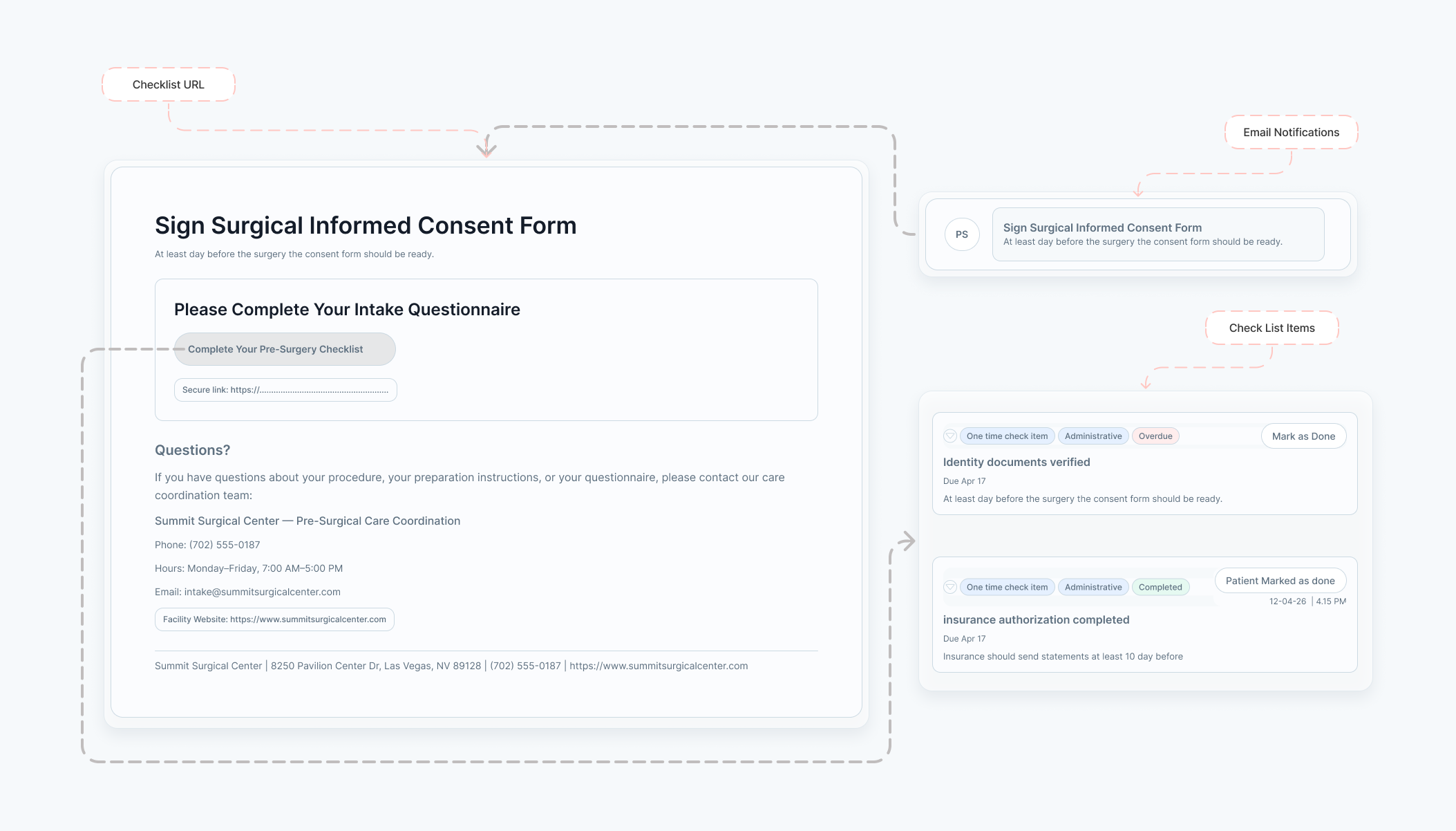
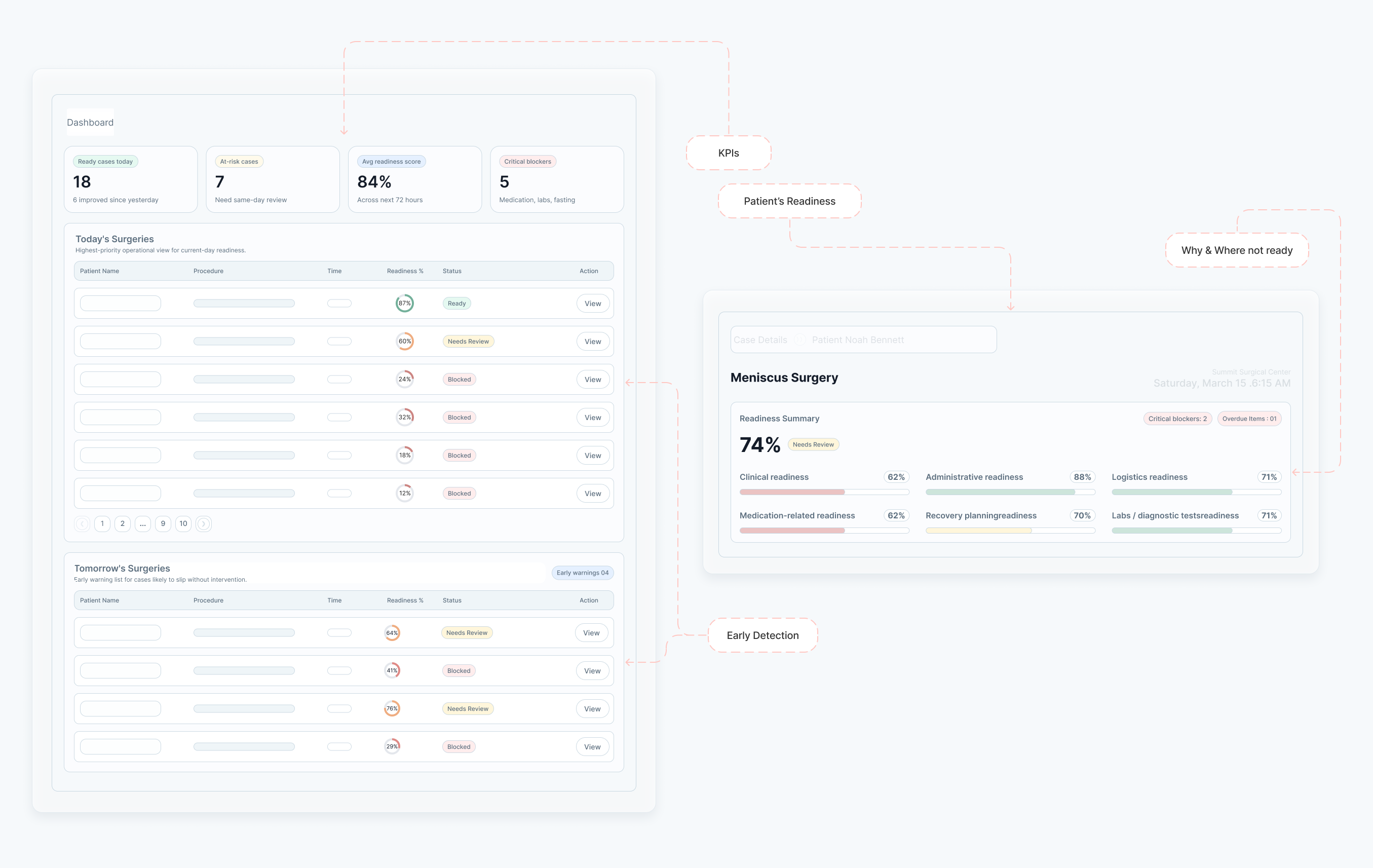
Once the patient has marked the items as done and submitted the checklist, on the other end the medical team is able to see how ready the patient is. In order to determine this, a readiness score was introduced, users are able to see, surgery by surgery, how ready each patient is for their procedure, along with daily stats on how many patients are ready and how many are not. Blockers are surfaced early, so prevention against unpreparedness is extended well before the day of surgery.
Summary
This case study explains how I analysed competitors and identified Gaps and Strong attributes of our product. Designed the product to Increase the user value and business value.